History of Python
-
Python is a high-level programming language created by Guido van Rossum and first released in 1991. It was designed with a focus on simplicity, readability, and developer productivity. Inspired by the ABC language, Python introduced clear syntax and powerful features that made it suitable for beginners as well as professionals
Who Created Python?
Python was created by Guido van Rossum, a Dutch programmer recognized for designing a language with clean, simple, and highly readable code.
When Was Python Developed?
Development Started: 1989 (late 1980s)
First Official Release: 1991
Python was developed while Guido van Rossum was working at CWI (Centrum Wiskunde & Informatica) in the Netherlands.
Why Was Python Created?
Guido van Rossum wanted a language that:
Was easy to learn and understand
Required fewer lines of code
Had clear and readable syntax
Could replace complex languages used at that time
Could improve productivity and development speed
Before Python – What Was the Problem?
During the 1980s, developers faced several challenges:
Popular languages like C, C++, Java, and Perl were powerful but complex, difficult to write, and hard to read.
Beginner-friendly languages existed, but they were too limited for real-world applications.
Developers needed a language that offered:
The power of high-level programming
Simplicity and ease of learning
Clean and readable syntax
Faster development with fewer lines of code
Python was created to solve exactly these problems.
Evolution of Python: Versions and Timeline
Python Timeline (Important Milestones)
1989 – Python Idea Started
Guido began working on the new language during Christmas holidays.
1991 – Python 0.9.0 Released
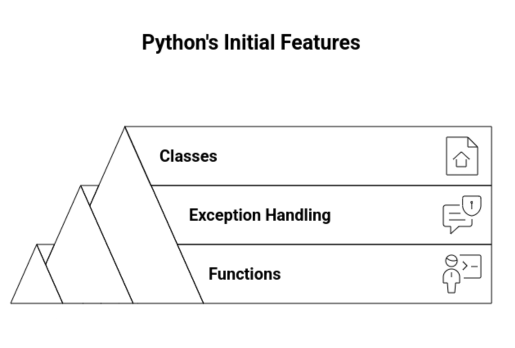
The first version included:
Functions
Exception handling
Classes
1994 – Python 1.0
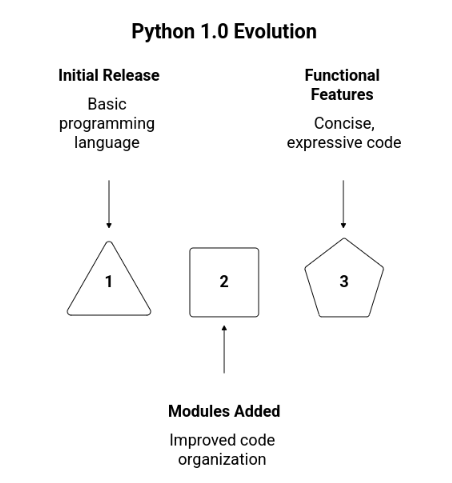
Python 1.0 marked the first major stable release. It introduced key features such as:
Modules for better code organization
Functional programming tools like map(), filter(), and reduce().
2000 – Python 2.0 Released
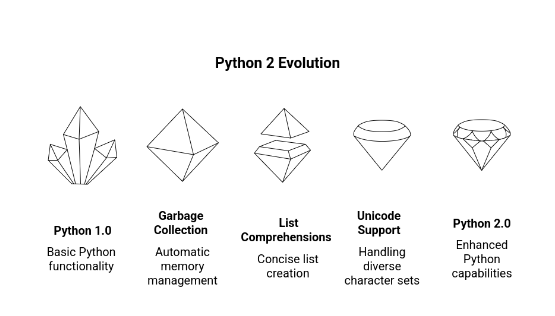
Python 2.0 introduced several powerful enhancements, including:
Automatic garbage collection for better memory management
List comprehensions for cleaner and more expressive loops
Improved Unicode support, making it easier to work with international text
Improved Unicode support, making it easier to work with international text.
2008 – Python 3.0
Python 3.0 was a major, backward-incompatible overhaul of the language. It introduced significant improvements, including:
Cleaner and more consistent syntax
Full Unicode support by default
A modernized and more organized standard library
2020 – End of Python 2 Support
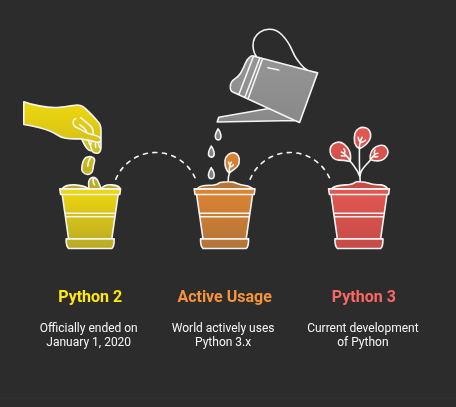
Python 2 officially reached end-of-life on January 1, 2020. Since then, the global developer community has fully transitioned to Python 3.x, which continues to receive active updates, improvements, and security fixes.
2025 (or latest) – Python 3.14 & Beyond
The latest major version is Python 3.14, officially released in 2025.
Python 3.14 continues the evolution of the language — building on the improvements of earlier 3.x releases, with better performance, newer syntax and features, and ongoing support from the community.